03/08/2026
Construction Jobs Yorkshire: Where the Opportunities Are in 2026
Construction jobs Yorkshire employers are advertising span one of the largest and most varied regional construction markets in the UK, covering everything from Leeds' continued city centre development through to Sheffield's advanced manufacturing-linked construction growth and a substantial housebuilding pipeline across the wider county. Yorkshire's combination of city regeneration, infrastructure investment and steady residential development has made it a genuinely strong region for construction careers at every level. This guide covers what the Yorkshire construction job market looks like in 2026, typical salaries, where demand is concentrated, and how to find the right role.
Why Yorkshire Offers Strong Construction Opportunities
Yorkshire's construction market benefits from real regional diversity rather than depending on a single city or project type. Leeds continues to see sustained city centre development, including commercial office space, residential towers and major transport-linked regeneration. Sheffield's construction activity increasingly ties into advanced manufacturing and industrial investment, while York, Hull and the wider East Riding contribute steady demand across housebuilding, heritage restoration and infrastructure work. This spread of activity across multiple sub-regions means Yorkshire's construction job market tends to be more resilient to localised downturns than regions dependent on a single major project pipeline.
The county's relatively lower cost of living compared with the South of England also continues to attract national contractors looking to deliver regional projects cost-effectively, creating a steady flow of both permanent and contract opportunities across the construction supply chain.
Which Construction Roles Are Most in Demand in Yorkshire
Residential Construction Trades
With substantial housebuilding activity across Leeds, Sheffield, Wakefield and the wider county, bricklayers, groundworkers, carpenters and general labourers remain some of the highest-volume vacancies across Yorkshire.
Site Management
Site Managers and Assistant Site Managers are in strong demand across both residential housebuilding and Leeds' ongoing commercial regeneration schemes, particularly candidates with SMSTS certification and multi-site experience.
Quantity Surveying
Yorkshire's quantity surveyor shortage reflects the national picture, with consistent demand at assistant, mid and senior level across contractors and consultancies delivering both public and private sector projects.
Civil and Structural Engineering
Yorkshire's transport infrastructure investment, alongside industrial and advanced manufacturing-linked construction around Sheffield, continues to drive strong demand for civil and structural engineers.
Heritage and Restoration Trades
York and several other Yorkshire towns have a notable heritage building stock, creating consistent demand for specialist trades experienced in traditional building methods and conservation-sensitive construction work.
Yorkshire Construction Salary Expectations
Yorkshire construction salaries generally sit below both London and Manchester rates, reflecting the region's lower cost of living, though specialist and senior roles remain competitive nationally. As a general guide:
- Apprentices and trainees: roughly £16,000–£22,000
- Skilled trades (bricklayers, carpenters, electricians): roughly £28,000–£38,000
- Assistant Quantity Surveyors / Assistant Site Managers: roughly £26,000–£34,000
- Quantity Surveyors / Site Managers: roughly £38,000–£54,000
- Senior Quantity Surveyors / Senior Site Managers: roughly £54,000–£70,000
- Commercial Managers / Project Managers: roughly £60,000–£85,000+
Roles based in Leeds typically sit toward the upper end of these ranges given the city's larger commercial construction pipeline, while more rural parts of Yorkshire generally sit closer to the lower end.
Top Areas Driving Construction Demand in Yorkshire
- Leeds City Centre — ongoing commercial and residential regeneration, including significant transport-linked development
- Sheffield — industrial and advanced manufacturing-linked construction growth
- Wakefield and the wider West Yorkshire — substantial residential housebuilding activity
- York — heritage restoration alongside steady residential development
- Hull and the East Riding — infrastructure and renewable energy-linked construction, particularly tied to the region's offshore wind supply chain
Many Yorkshire construction roles involve travel between sites across the county, so it's worth clarifying the specific project locations and any travel expectations during the recruitment process.
Skills That Make You More Competitive in Yorkshire
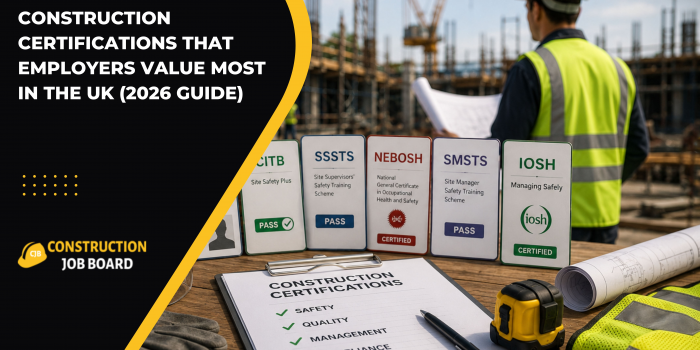
- CSCS card — essential for the vast majority of site-based construction roles across Yorkshire.
- SMSTS or SSSTS certification — increasingly expected for supervisory roles, even at assistant level.
- Heritage and conservation experience — a genuine differentiator for trades and professionals working across York and other heritage-dense towns.
- Renewable energy and infrastructure experience — increasingly valuable given growing activity linked to the East Coast offshore wind supply chain around Hull.
- Multi-site flexibility — given Yorkshire's spread-out project pipeline, candidates comfortable travelling between sites across the county are consistently in stronger demand.
How to Find Construction Jobs in Yorkshire Effectively
- Use a specialist construction job board that lets you filter by Yorkshire city or sub-region, since general job sites often bundle Yorkshire roles together without clear geographic detail.
- Register your CV directly with construction recruitment agencies covering Leeds, Sheffield and the wider Yorkshire region, many of which maintain strong relationships with regional contractors.
- Set up job alerts specific to your target Yorkshire city or sub-region to catch new vacancies as soon as they're posted.
- Highlight regional project experience — familiarity with Yorkshire's specific mix of heritage, residential and industrial construction work can meaningfully strengthen applications to local employers.
- Consider contract roles for specialist trades — Yorkshire's varied project pipeline means contract opportunities are widely available, particularly for experienced tradespeople and commercial professionals.
Regional Variations Within Yorkshire
It's worth noting that Yorkshire's construction market isn't uniform — Leeds' commercial and residential construction pipeline looks quite different from Sheffield's industrial-linked activity, or York's heritage-focused work. When searching for roles, it's often more useful to think in terms of these Yorkshire sub-regions rather than treating "Yorkshire" as a single homogenous job market, since salary expectations, project types and required skills can vary meaningfully between them.
The Skills Shortage and What It Means for Jobseekers
Like most of the UK, Yorkshire faces an ongoing construction skills shortage, particularly in quantity surveying, site management and several skilled trades. This creates genuine opportunity for candidates with relevant certifications and demonstrable experience, who are often able to negotiate stronger packages and greater flexibility than in more saturated regional markets.
Common Mistakes Jobseekers Make in Yorkshire
A handful of avoidable issues account for many unsuccessful applications across Yorkshire's construction market:
- Treating "Yorkshire" as a single job market. Applications that don't reflect awareness of the meaningful differences between Leeds' commercial pipeline, Sheffield's industrial focus and York's heritage work often come across as generic to local employers.
- Overlooking smaller regional contractors. Many candidates focus applications exclusively on large national contractors, missing genuine opportunities at well-established regional firms that often move faster through recruitment and offer earlier responsibility.
- Letting safety certifications lapse. As across the rest of the UK, CSCS cards and safety tickets with expired dates are one of the most common reasons strong candidates are screened out early.
- Not highlighting site travel flexibility. Given Yorkshire's spread-out project pipeline, candidates who clearly signal willingness to travel between sites across the county often access a meaningfully wider range of opportunities.
What Employers in Yorkshire Are Looking For
Beyond core qualifications, Yorkshire employers consistently value candidates who understand the practical realities of working across a geographically spread region — reliable transport, flexibility around site locations, and genuine familiarity with local project types all count in a candidate's favour. For heritage and conservation-adjacent roles in particular, employers place real weight on demonstrable experience with traditional materials and techniques, since this expertise remains genuinely scarce relative to demand. Commercial and management candidates who can show experience working across both public sector and private residential projects also tend to stand out, given how varied Yorkshire's client base is compared with more homogenous regional markets.
Final Thoughts
Yorkshire's construction job market offers genuine regional diversity, spanning city centre regeneration in Leeds, industrial growth around Sheffield, heritage work in York and infrastructure activity tied to Hull's renewable energy supply chain. For construction professionals and tradespeople looking for consistent demand without London or Manchester-level living costs, Yorkshire remains one of the UK's strongest and most varied regional construction markets.
Frequently Asked Questions
What is the average construction salary in Yorkshire?
Skilled trades in Yorkshire typically earn between £28,000 and £38,000, while Quantity Surveyors and Site Managers commonly earn £38,000–£54,000, with senior commercial roles reaching £60,000–£85,000 or more.
Which Yorkshire city has the most construction jobs?
Leeds generally offers the highest volume of construction vacancies in Yorkshire, driven by ongoing commercial and residential regeneration, though Sheffield and Wakefield also show strong and consistent demand.
Do I need a CSCS card for construction jobs in Yorkshire?
Yes, a valid CSCS card is required for the vast majority of site-based construction roles across Yorkshire and is typically checked early in the recruitment process.
Is there demand for heritage construction skills in Yorkshire?
Yes, particularly in York and several other Yorkshire towns with significant heritage building stock, where conservation-sensitive construction experience is a genuine differentiator for both trades and professionals.
What construction roles are hardest to fill in Yorkshire?
Quantity Surveyors, Site Managers, bricklayers and groundworkers are consistently among the hardest roles to fill across Yorkshire, reflecting the broader UK-wide construction skills shortage.
How can I find construction jobs in Yorkshire quickly?
Using a specialist construction job board with city or sub-region filters, registering with Yorkshire-focused recruitment agencies, and setting up targeted job alerts are the most effective ways to surface relevant vacancies quickly.